
Most small business owners we talk to in Windsor-Essex have the same reaction when someone mentions AI: a cautious nod, followed by “we’re keeping an eye on it.” They’ve watched larger competitors roll out chatbots, personalized recommendations, and slick automated email flows, and they’re not sure where to start — or whether any of it would actually help them.
Here’s the news: it would. Probably more than you think.
The window where AI was a fringe enterprise novelty closed sometime in 2024. The tools are now cheap, well-documented, and integrate cleanly into standard websites — including the WordPress, Shopify, and custom builds we host every day. The barrier isn’t cost or complexity anymore. It’s knowing which integrations actually move the needle for your business, and which are just shiny.
This post is about the ones that work.
1. A real customer-service chatbot on your contact page
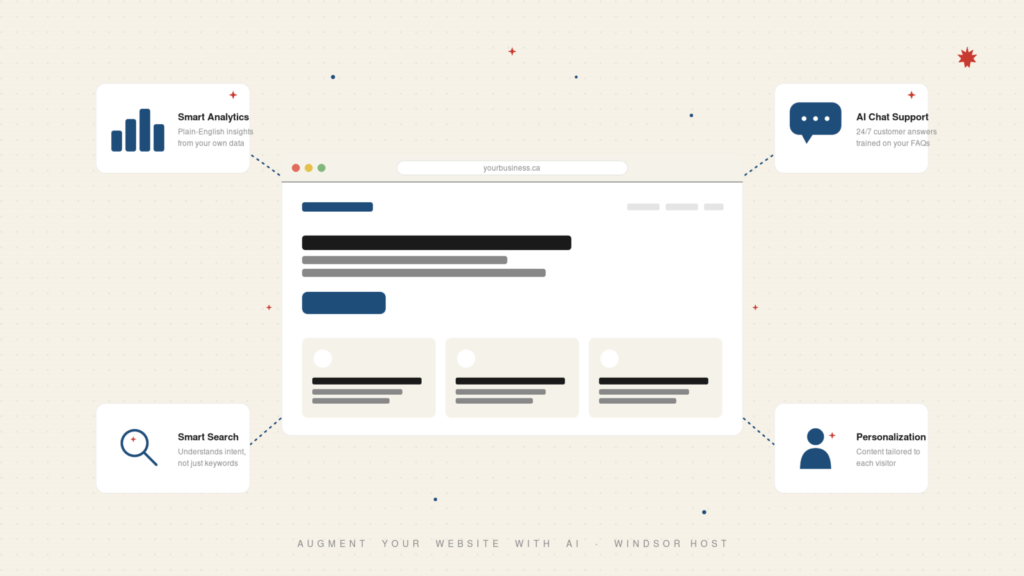
Skip the cute-mascot version. The version that pays for itself is one trained on your own FAQs, return policies, service areas, hours, and pricing tiers. A customer asks a question at 9pm on a Saturday; they get a usable answer instantly; if the bot can’t help, it captures their email and routes the question to your inbox by Monday morning.
We’ve seen these reduce inbound “where’s my order?” or “do you ship to…” enquiries by 40 to 60 percent within the first month. The running cost for a typical small business sits around twenty to forty dollars a month in API fees, plus a one-time setup. The return is a contact form that no longer goes silent overnight, and a sales team that gets to focus on the questions that actually need a human.
2. AI-powered site search
Most small business sites have either no search bar or one that returns “0 results” the moment a customer phrases something unexpectedly. AI search understands intent. Someone types “phone repair near Lakeshore” on a multi-location repair site and lands on the Lakeshore page, even if that exact phrase isn’t anywhere in your content.
For e-commerce sites this is the single biggest conversion lever after page speed. We’ve integrated tools like Algolia AI, MeiliSearch, and Typesense for clients running large catalogues, and the lift in conversion from search-driven traffic is consistently in double digits. For service sites, the same principle applies — visitors who use search convert two to three times more often than visitors who don’t, and AI search just makes that search bar work.
3. Automated content production — with human judgment in the loop
The internet does not need more AI-generated blog posts for the sake of it. But there’s a real role for AI in two places: drafting first passes of long-form content that a human then edits, and producing the high-volume small content nobody has time to write — product descriptions, location pages, alt text, meta descriptions, FAQ entries.
A retail client of ours had eighty product pages with copy that dated back to 2019. We rebuilt every page with AI-drafted, human-reviewed descriptions in two weeks. Their organic traffic on those pages tripled within three months. That work would have taken six months with a freelance copywriter, at five times the cost.
The point isn’t to replace your voice. It’s to give you back the hours you’d otherwise spend on the writing nobody reads anyway, so the writing that matters can actually be good.
4. Predictive personalization that doesn’t feel creepy
The version of personalization that works for small businesses isn’t tracking visitors across the open web. It’s much simpler. When a returning visitor comes back, show them content related to what they looked at last time. When someone is reading a service page, suggest two related case studies. When someone abandons a cart, send a follow-up email written specifically for the items they left behind, not a generic “you forgot something.”
These aren’t experimental features anymore. They’re table stakes for any e-commerce site doing more than fifty thousand a month in revenue, and they’re increasingly common on service sites too. The setup is one-time. The lift compounds quietly month over month.
5. Internal tools that save the owner’s time
This is the least-discussed but highest-ROI category, and it’s where we’ve watched the biggest shifts in the last twelve months. AI assistants that read your inbox and draft responses in your voice. Tools that pull up a customer’s full history the moment a call comes in. Automated booking and rescheduling. Transcript-and-summary for every sales call. Dashboards that answer plain-English questions like “which products had the best margin last quarter?” without you needing to write a query.
Most owners are still doing this work themselves at 11pm. AI doesn’t replace that work — it removes the parts that don’t need a human in the loop, so the parts that do get the attention they deserve.
Why “augment” is the right word
You don’t need to rebuild your business around AI. The companies winning right now aren’t the ones doing AI-first product launches. They’re the ones quietly bolting smart features onto sites and workflows that already work. The hosting stays the same. The CMS stays the same. The team mostly stays the same. What changes is that a website that used to be a static brochure starts behaving like a twenty-four-hour employee.
That’s the work we do at Windsor Host. We’re not an AI company. We’re the people you already trust with your website, your domain, your email, and your hosting — and we’ve spent the last eighteen months learning how to integrate the AI services that actually pay for themselves, so our clients don’t have to figure it out from scratch.
If you’ve been wondering whether any of this applies to your business, the fastest way to find out is a twenty-minute conversation. We’ll look at what you have, identify the two or three integrations most likely to move your numbers, and tell you honestly if it’s not worth doing yet. No upsell pressure, no buzzword bingo.
Ready to see what AI can actually do for your business?
We’ll review your site, your goals, and your day-to-day workflow, then send you back a short, plain-English plan with what we’d recommend, what it would cost, and what it would change. Hosted in Canada. Built in Windsor-Essex. Honest answers either way.